Wednesday

As Australian as a Mannequin in a Museum

Is the use of shop mannequins in museum exhibits a peculiarly Australian phenomenon? Overseas, I’ve noticed dioramas — miniature three-dimensional scenes crafted by artisans — are the standard for history and heritage displays. And if life-sized figures are a must, then faceless models made specifically for the museum industry are used. But here, curators seem to prefer to use the every day retail dummy to re-create Australia’s past. This would be a winning tactic … if those selected were not yesterday’s models, banished from fashion boutiques for their chipped skins and 1980s styling.

For example, in my local museum (the Yass and District Museum), a mannequin with shiny nude lips, too much apricot blush and intense coral eye-shadow re-enacts the role of a genteel pioneer woman sipping tea. One gets the feeling she wants to trade her frilly white cap, crystal cake plates and antique mantelpiece for leg warmers, shoulder pads and a swag of Madonna-style crucifixes.

The result is a warped experience of history — somehow my memories of Rubik’s cube and fluorescent socks sneak into lessons on explorers and bush kitchens.

The upside, however, is that most shop mannequins are female, which gives curators opportunities to re-create domestic or nurturing scenes, for which relics appear to be abundant. For instance, a restored school is the showcase of the Goomalling Museum in Western Australia’s Wheatbelt. The school marm is a mannequin with smoky, come-hither eyes and arms bent to carry a designer handbag. Equally charming, is the foam apple on her desk, out of which someone has attempted a bite.

In Mount Pinatubo's Shadow

At 5:15 am, bats are feasting on tropical fruit in the trees above. It’s dark, but Manila’s congested streets are well-and-truly awake. My destination is just north of suburbia, but in a city where a competent jogger can out-run the traffic, that means a three hour journey. A local church minister has invited me to a village in the Province of Bulacan, where he and his team of volunteers regularly provide aid to the people many believe are the Philippines’ original ethnic group.

The Aeta (pronounced “eye-ta”) are unlike other Filipinos. Dark and petite with tightly-curled hair, they look more African than Asian, a difference that automatically makes them unpopular in a country that cherishes pale skin to the point where bleaching creams are sold at supermarket check-outs.

Not surprisingly, the Aeta live on the social edge. A Filipino volunteer named Jerry explains the situation: “People think the Aeta are lazy and uncivilised,” he says. “So they haven’t been given access to education, housing and healthcare.”

With Manila’s mania behind us, we find ourselves alone on a track of grey sand. This is “lahar”, Jerry says — volcanic ash that gushes from an eruption as fast as the average passenger train. Nearby Mount Pinatubo exploded into the record books in 1991 with the most violent land-based eruption of the twentieth century, smothering people and homes throughout this area. Jerry points to glimpses of remnant roofs poking through the ground. Life for the Aeta certainly hasn’t been kind.

However, as we reach the outskirts of our destination, it's clear the area has renewed in the intervening years. As we pass bundles of food and clothing from our van’s windows, people burst from homes made of bamboo and woven banana leaves. The size of my kitchen, an extended family squeezes into each one.

By the time we reach the village centre, word is out that the minister has brought two Westerner visitors, myself and Tim, an American engineer on a short contract in the Philippines. White skin is so rare here that adults gape. A few children hide behind a carabao (water buffalo) harnessed to a cart, while the more adventurous pat my freckled arms.

I try to be more subtle with my own curiousity, peeking at babies sitting with their bare bottoms in the dirt, men in traditional loincloths hacking leaves from crimson bananas flowers with machetes, and everyone with their feet splayed and cracked from lives without shoes.

After providing a meal of fish and rice, we give away more bags of food and clothes, especially to a few elderly ladies, whose rags barely cover their time-worn bodies. Tim fetches his guitar from the van, plucks at the strings and sings for the children, who are adorable, despite the flies sucking moisture from their dirt-smudged faces. A woman produces her own guitar — a home-made version with five strings — and her friends hoot and giggle as they grab our hands for an impromptu lesson in traditional dancing. Joy, I realise, has nothing to do with status and wealth.

Still, that doesn’t make it less touching when Tim pulls his guitar out again on our drive back to Manila’s mushroom-cloud of bustle and pollution. He sings 500 Miles by Peter, Paul and Mary: “Not a shirt on my back, not a penny to my name; Lord I can’t go a-home this a-way….”
Thursday

From Murder to Medicine


Fifty years ago, five young American missionaries flew their small Mission Aviation Fellowship plane into Ecuador’s eastern jungle, aiming to win the country’s fiercest head-hunting warriors to Christianity. The Waorani people, then known as Auca, responded with barbed spears, butchering the visitors and ransacking their plane.

It would be easy to assume this was the last contact between the MAF and the Waorani. Not so. The event sparked an influx of volunteers wishing to carry on the work of the men now known as the “five martyrs”. Today, MAF workers provide vital services, including air ambulances, to one of the least Westernised tribes in South America. What’s more, travellers can join pilots, as suitable, on their daily flights for a unique glimpse of remote Amazon village life, accessible only by air.

An international organisation, MAF has three bases in Ecuador, including one in Shell, a peaceful town in the Southern Oriente. Two hours from BaƱos and 20 minutes from Puyo, it’s not a tourist destination — in fact, it owes its existence to the oil company of the same name, a military airbase and a cluster of American missionary groups.

My MAF flight starts with an ID check by local military and a weigh-in at the mission’s hangar. My fellow travellers include a nurse from Hospital Vozandes (run by HCJB missionaries) and a recovered patient returning to his jungle home. Our other “companions” will travel in the hold — two giant, gasping catfish, as long as my arm-span and wrapped in wet cloths. At other times, passengers include mothers with newborns, snake-bite victims, government teams undertaking immunisation and health education programs, and clucking chickens.

From the air, the jungle looks like a never-ending expanse of broccoli florets. The tiny Cessna buzzes and rattles, and we chat with our pilot, who clearly knows this journey inside-out. After 30 minutes, we descend onto a slick jungle airstrip and Waorani people rush to meet us.

The village is hot and humid, filled with sweet fruity scents and chirping crickets and frogs. Its people belie their heritage of head-shrinking, cannibalism and vicious blood feuds. Instead, they are delighted to show us their village — a rambling cluster of thatched huts on stilts. We are invited into a one-roomed home and feast on finger bananas while the woman of the house mends a woven bag. Three shy girls sit under hanging bunches of green bananas, while a couple of boys giggle and sway in a hammock.

Then we paddle nearby in a shallow river, watching women with swift reflexes snatch hand-sized fish from the water. A pet monkey rattles overhanging branches and butterflies drift by like scraps of blue and orange paper.

As we buckle up to leave, children press their huge dark eyes against the plane’s windows. The grass on the runway whirls and flattens as we take off and they dash after us on broad, splayed feet never touched by shoes — as thrilled as we are by an encounter with people from an unfamiliar world.

This story is based on my experiences while doing volunteer aid work in Ecuador and is one of two being published in April in the V!VA List, Latin America — an arm-chair travel book published by Viva Travel Guides and featuring 333 Latin experiences from writers and photographers around the world. See www.vivatravelguides.com/viva-list/ for more information.

Saturday

Photographing Four Dummies

The set-up of Ross’s Relics — a shop of collectibles and kitsch on Comur Street, Yass — is perhaps more curious than its curios. With nooks suspiciously like bank safes and some two dozen rooms of stock that appear to be dynamited into place, I’m surprised browsers aren’t advised to enter at their own risk.

Of course, this bank heist look is part of its appeal. In fact, junk store fans treat the shop as a museum, a half-day trip down memory lane — “I haven’t seen this since I wore knee high socks,” they sigh, or for my generation, “Grandma owned one of these”.

For me, the shop’s display mannequins are a real treat. I once found a male model split in two, his ‘70s mustached torso lounging on a club sofa, while his trousered legs sat nearby at a grand piano. I recently photographed the row of mannequins outside the front door with my Truview (Diana clone) toy camera. A cross between blow-up dolls and side-show clowns, their mouths are questionably agape and their hair covers the spectrum of fairy-floss colours.

I’ve realised I have a penchant for photographing dummies — the more provocative or ridiculous, the better — so look out for more images of pretend people in future! I’ve realised I have a penchant for photographing dummies — the more provocative or ridiculous, the better — so look out for more images of pretend people in future!

Friday

Biography


Kathleen Fisher lives in Yass, a little country town not far from Canberra, Australia's capital.

Some would say Kathleen is a junk store addict, but in polite company she prefers the term "collector". However, the fact remains that she has far more cameras than sense, can't resist vintage sewing supplies and keeps ephemera that "might be useful one day" in old suitcases.

She lives with her husband Justin, who shares her fondness for champagne and detective fiction. They live at the whim of seven pets — three cats, two dogs, one horse and a guinea pig.

Artist Statement

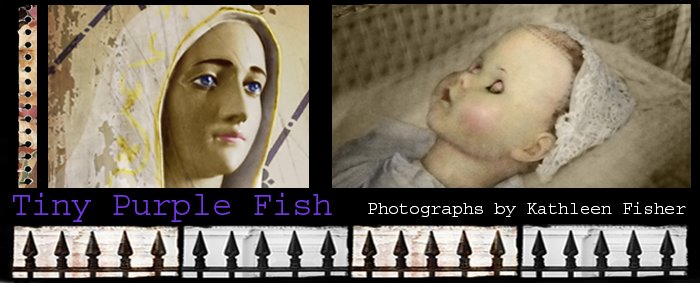
Kathleen Fisher was born in a town she never lived in, a small community in Western Australia’s wheatbelt. This may explain her fascination with both notions of home and rural life. She is also attracted to religion — notably Christianity, with its stories, icons and architecture — and history, including the ravages time has on buildings and human emotions.

Kathleen sees photography as a way of “making” images, rather than capturing “reality”. As such, she enjoys experimenting with plastic cameras, photomontage, mixed media and using a scanner as a substitute camera. She is drawn to techniques that foreground the photographic process, such as altered photographs, overlapped images and visible sprocket holes.

An analytical person, Kathleen’s work is usually narrative. She enjoys using juxtaposition, irony and humour to reveal her distinct interpretations. At the same time, she embraces accidents and co-incidents, which so often make the best images.

Kathleen has a Bachelor of Arts (English) (Honours) from Curtin University of Technology and a Graduate Certificate of Communications (Photomedia) from Edith Cowan University. She taught media and communications at Edith Cowan University for two years, and has written feature articles about art for a number of publications.

Exhibitions

Solo
2009
• “Dumb-Founded”, PhotoAccess, Canberra


Group
2011
• "Creative Alchemy", Belconnen Arts Centre, Canberra
• "Project: Art Journal", made.Creative Space, Toowoomba
• "BSG $10,000 Art Prize and Exhibition", Brunswick Street Gallery, Melbourne
• "Canberra in a Matchbox", PhotoAccess, Canberra

2010
• “HIY2010", PhotoAccess, Canberra

2009
• “HIY2009", PhotoAccess, Canberra

2008
• “deLiver", Art At The Heart 2008: Regional Arts Australia National Conference , Alice Springs
• “HIY2008", PhotoAccess, Canberra
• “Body Moves”, New Works Art Gallery, Canberra

2007
“Recycled Materials in Art”, The Artists Shed, Queanbeyan
“Wasteland”, Tuggeranong Arts Centre, Canberra

2006
“Wasteland”, Belconnen Gallery, Canberra
“Red Lens”, Charles Sturt University, Dubbo
“Canberra Photographic Society 60th Anniversary Exhibition”, Canberra Museum and Gallery, Canberra
“Wildside?”, PhotoAccess, Canberra

Collections

PANDORA, National Library of Australia